
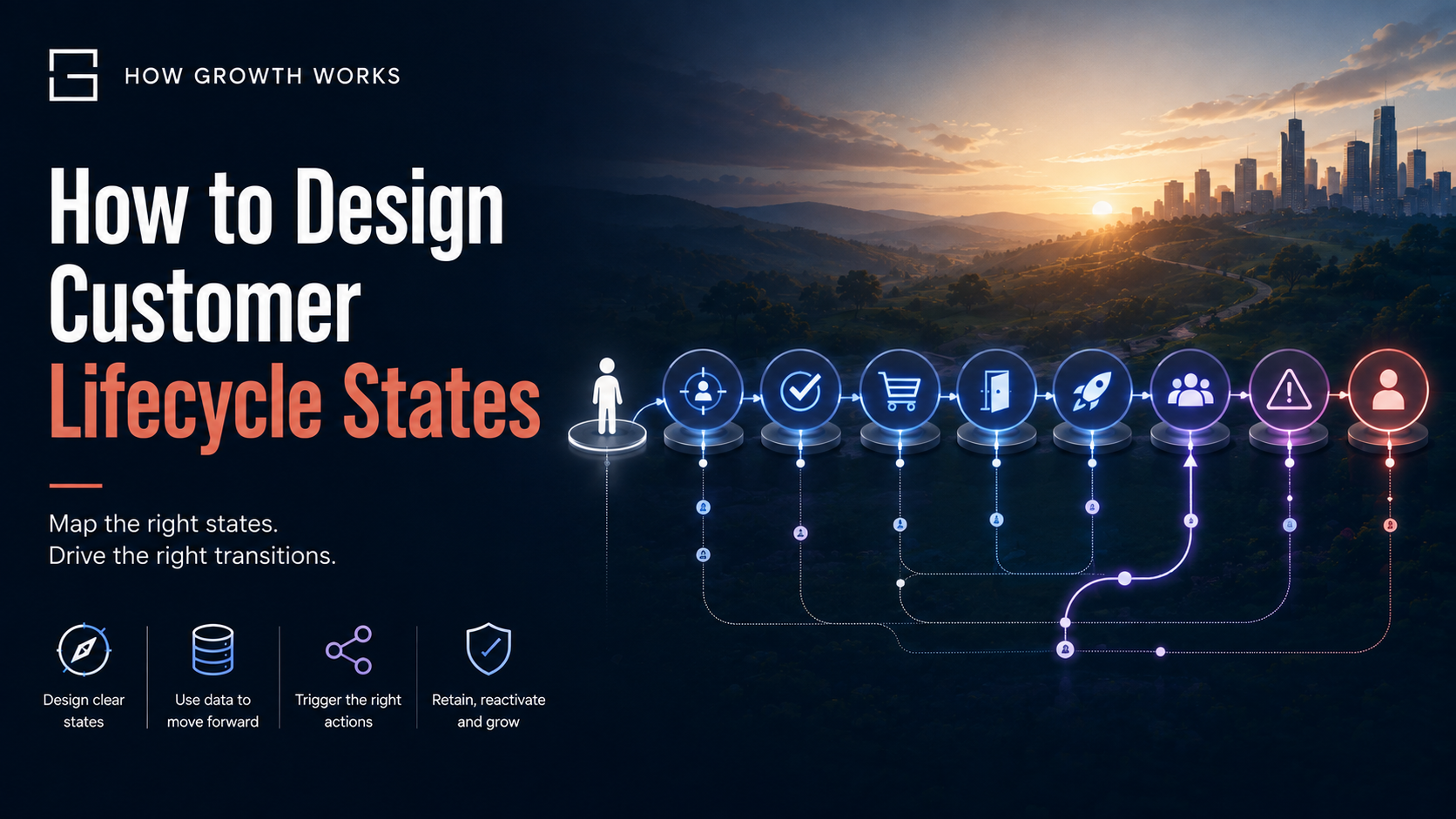
A growing business eventually develops several different answers to a deceptively simple question:
Where is this customer now?
The CRM says Customer.
The billing system says Active.
The product database says Onboarding.
The lifecycle platform says Subscriber.
Analytics says Activated.
Customer Success says At Risk.
At first glance, this looks like a data-quality problem.
Sometimes it is.
But sometimes every one of those labels is technically correct. They are simply describing different aspects of the customer relationship.
That distinction matters.
Because the goal of customer lifecycle architecture is not to make every platform display the same status. It is to make the customer’s relationship with the business sufficiently explicit that people and systems can understand what is true, what happened, and what should happen next.
A useful lifecycle architecture should answer six questions:
- Where is this customer now?
- What happened to put them there?
- Which system knows that?
- What should happen because of it?
- What would move them into another state?
- What happens when systems disagree?
Most businesses do not start with this architecture.
They accumulate it.
A CRM introduces lifecycle stages. The email platform adds tags. Billing has subscription statuses. Product analytics has behavioral cohorts. Automations add their own flags. Sales creates another field. Customer Success builds a spreadsheet.
Eventually the business has many representations of the customer, but no agreed model of customer state.
The solution is not necessarily another tool.
It is better lifecycle design.
What Is Customer State?
Customer state is a current, decision-relevant representation of a meaningful aspect of a person or account’s relationship with the business.
A lifecycle state is more specific:
Lifecycle state is the current operational representation of where a defined entity sits within a meaningful relationship progression with the business.
The phrase defined entity is important.
Whose lifecycle are you modelling?
A person?
A company account?
A subscription?
A product licence?
A course enrolment?
In a simple consumer subscription business, the person and the subscription may appear almost interchangeable.
In a B2B software company, they are not.
An account might contain 200 users. Some may be highly active. Some may never have logged in. The account itself might be approaching renewal while individual users occupy very different product states.
In a multi-product business, one customer can be active in one product and churned from another.
Before designing lifecycle states, you therefore need to know what object the state belongs to.
Without that, even a technically clean status field can become ambiguous.
Customer State Is Not the Same as Customer Data
One reason lifecycle architectures become messy is that different kinds of customer information get collapsed together.
Consider the following:
Event: subscription_cancelled
State: Cancelled
Attribute: Plan = Pro
Behavior: Used the reporting feature 12 times this month
Segment: High-value SaaS customers
Score: Churn risk = 0.72
History: Activated on 14 March, upgraded on 22 May, cancelled on 4 August
These are not interchangeable.
An event records that something happened.
An attribute describes something currently known about an entity.
Behavior is observed activity over time.
A segment groups customers that meet particular conditions.
A score represents a calculated assessment.
History preserves what changed and when.
A state represents something that is currently true and operationally meaningful.
This distinction becomes especially important because modern growth platforms make it easy to use any of these concepts to trigger automation.
A segment can launch a campaign.
An event can start a workflow.
An attribute can change messaging.
A score can create a Customer Success task.
That does not make all of them lifecycle states.
A useful lifecycle architecture keeps these concepts separate enough that the business still understands what each one means.
Lifecycle State Is Not Segmentation
Segmentation answers:
Which customers currently match these criteria?
Lifecycle state answers something closer to:
Where does this customer currently stand in this particular relationship progression?
A customer may belong simultaneously to segments such as:
- Enterprise Accounts
- UK Customers
- Interested in Analytics
- MRR Above £1,000
- Used Reporting This Week
- High Expansion Potential
Those classifications may influence treatment.
But turning all of them into values inside one customer_status field would produce an impossible model.
This is one of the most common conceptual mistakes in lifecycle design: attempting to represent every useful customer distinction as a stage.
Not every important customer fact is a lifecycle state.
Start With Consequences, Not Funnel Diagrams
Most lifecycle exercises begin by drawing stages:
Visitor → Lead → Qualified → Customer → Active → Churned.
It looks tidy.
But neat diagrams are not the objective.
A stronger starting question is:
At which changes in the customer relationship should the business behave differently?
This leads to one of the most useful principles for designing lifecycle states:
A lifecycle state is worth representing when a meaningful change in the customer relationship should change how the business measures, communicates with, serves or acts toward that customer.
Suppose a business proposes four stages:
New Customer
Early Customer
Developing Customer
Established Customer
What changes when someone moves between them?
If the answer is nothing, those distinctions may not need to exist operationally.
Now compare:
Onboarding
Activated
At Risk
Those changes may affect:
- communications;
- product guidance;
- Customer Success activity;
- offer eligibility;
- experiment eligibility;
- retention measurement;
- AI or automation behavior.
Those states pass what we can call the consequence test.
If changing the state changes nothing meaningful, question whether the state needs to exist.
There Is No Universal Customer Lifecycle
The familiar progression:
Visitor → Lead → Qualified → Buyer → Onboarding → Activated → Active → At Risk → Churned
is useful as a thinking aid.
It is not a universal architecture.
Different business models have genuinely different customer relationships.
A sales-led B2B SaaS business might need:
Lead → Qualified → Opportunity → Customer
for the commercial journey, while separately tracking:
Onboarding → Activated → Active → At Risk
for the product relationship.
A self-serve SaaS product might care more about:
Signup → Trial → Activated → Paid → Active → Cancelled
An e-commerce company might use:
Subscriber → First-time Buyer → Repeat Buyer → Active Customer → Lapsed
A subscription publication might model:
Registered → Subscriber → Engaged Subscriber → At Risk → Cancelled → Former Subscriber
An education business could use:
Buyer → Started → Activated → Progressing → Completed
Here, Completed may represent success rather than churn.
A marketplace may require separate lifecycles for the same person’s buyer and seller relationships.
The right lifecycle model therefore cannot be copied from another company or selected from a CRM dropdown.
It must be derived from how your business actually creates, delivers and retains value.
Important State Transitions Should Be Explainable
For every meaningful lifecycle transition, ask:
What happened?
A form was submitted.
Qualification criteria were satisfied.
An opportunity was created.
Payment succeeded.
An account was provisioned.
Activation criteria were met.
Cancellation was confirmed.
Access expired.
Those events or conditions can establish state transitions such as:
Form submitted → Lead
Qualification criteria met → Qualified
Payment succeeded → Buyer
Account provisioned → Onboarding
Activation criteria met → Activated
Cancellation confirmed → Cancelled
Entitlement expired → Churned
The exact mapping will differ between businesses.
The architectural principle is more general:
Important lifecycle states should normally have identifiable entry conditions and identifiable exit conditions.
That makes the system governable.
“Customer satisfied activation criteria at 14:32” can be investigated.
“Marketing thinks this person is engaged” is considerably harder to operationalize.
Event-Based State and Derived State Are Different
Some states have a clear transition event.
payment_succeeded is observable.
subscription_cancelled is observable.
Other states are inferred.
At Risk is the obvious example.
A business might classify a customer as At Risk because:
- usage has fallen;
- key users stopped logging in;
- payments failed;
- support sentiment deteriorated;
- seat utilisation declined;
- renewal is approaching;
- some combination of those factors crossed a threshold.
There may be no single customer_became_at_risk event in the underlying world.
The state is calculated.
That makes it a derived state.
Derived states can be extremely useful, but they need particularly clear governance.
You need to know:
- which facts contribute to the calculation;
- which system calculates it;
- how often it refreshes;
- when it expires;
- what overrides it;
- what happens if source data is missing.
Otherwise a customer can remain labelled At Risk long after the conditions that generated the classification have disappeared.
Activation Needs a Real Definition
Few lifecycle terms are used more loosely than activated.
Account created does not necessarily mean activated.
Logged in once does not necessarily mean activated.
Completed onboarding does not necessarily mean activated.
Opened the welcome email certainly does not mean activated.
Activation should represent evidence that the customer has reached an early value threshold associated with successful use of the product or service.
The phrase “associated with” matters.
Imagine a project-management product.
The team initially defines activation as:
account_created
It is easy to measure.
It is also almost meaningless.
Later, analysis shows that customers who invite two colleagues and complete their first project during the first week retain substantially better.
That behavior might become a much stronger activation proxy.
But even then, precision matters.
The company has found a behavior associated with later success. It has not necessarily proved that forcing customers to perform that behavior will cause retention.
A mature activation definition often develops through three stages:
Plausible activation hypothesis
An action seems likely to represent early value.
Behaviorally supported activation metric
Cohort analysis shows that customers who perform the action are materially more likely to retain or succeed.
Experimentally informed understanding
Testing helps determine whether interventions that increase the behavior also improve downstream outcomes.
Many businesses never need the third level.
But they should at least distinguish a convenient onboarding event from a genuinely useful activation signal.
Buyer Is Not the Same as Active
One of the most damaging lifecycle shortcuts is treating commercial state and product state as the same thing.
A customer can be:
Paid but not activated.
Activated while on a free plan.
Cancelled but still entitled to service until the end of the billing period.
Commercially churned but still subscribed to permitted marketing communications.
Active in one product but churned from another.
Subscription billing systems make this distinction obvious.
A billing platform may have statuses such as:
Trialing
Active
Past Due
Cancelled
Unpaid
Those statuses describe a subscription.
They are not complete representations of the customer relationship.
An active subscription does not automatically mean the user is actively receiving value.
A cancelled subscription does not necessarily mean access has ended today.
This leads to a second important test for lifecycle architecture:
The Domain Test
When two systems disagree, ask:
Are they describing the same fact, or different dimensions of the relationship?
Consider:
CRM: Customer
Billing: Cancelled
Product: Account Enabled
Analytics: Activated
Those values may all be correct.
The CRM may mean the account has historically converted.
Billing may mean the subscription will not renew.
Product may mean access continues until the end of the paid term.
Activated may be a historical milestone that remains true indefinitely.
This is legitimate multidimensional state.
Now imagine:
Product: Activated
Lifecycle Platform: Onboarding
Both systems are attempting to represent the same product relationship, and the onboarding state should have ended when activation occurred.
That is an actual state conflict.
A professional architecture should preserve legitimate differences while eliminating contradictory representations of the same fact.
Do You Need More Than One State Domain?
Sometimes.
A business may need separate representations of:
Commercial state
Trial, paid, past due, cancelled.
Product state
Provisioned, onboarding, activated, inactive.
Marketing consent state
Subscribed, unsubscribed, restricted.
Risk state
Healthy, at risk, recovering.
But this principle is easy to overapply.
The objective is not to create five new status fields because five domains sound sophisticated.
The objective is to stop fundamentally different facts being compressed into one meaningless customer_status property.
Use the smallest number of state domains that your business genuinely needs.
State Should Drive Behavior
Lifecycle state becomes useful when it changes what the growth infrastructure does.
Consider Onboarding.
Entering that state might:
- begin onboarding communications;
- enable contextual product guidance;
- start activation monitoring;
- suppress acquisition messages;
- create a Customer Success task;
- begin measuring time to activation.
Moving to Activated might:
- end beginner onboarding;
- record an activation milestone;
- begin the active-customer lifecycle;
- establish a retention cohort;
- eventually make expansion messaging appropriate.
Moving to At Risk might:
- trigger retention intervention;
- suppress expansion messaging;
- increase Customer Success attention;
- change automated communication;
- surface risk operationally.
None of these consequences should be copied blindly.
The point is architectural:
State should have consequences.
If the business changes a lifecycle state but every system behaves exactly as before, the value of that state is questionable.
A State Transition Architecture
For every important lifecycle transition, document the following chain:
EVENT
↓
STATE TRANSITION
↓
AUTHORITATIVE OWNER
↓
STATE DISTRIBUTION
↓
SYSTEM ACTIONS
↓
MEASUREMENT
For example:
activation_criteria_met
↓
Onboarding → Activated
↓
Product system
↓
CRM + lifecycle platform + analytics
↓
Stop onboarding + begin active lifecycle
↓
Record activation and establish retention cohort
This is where lifecycle design connects directly to the wider growth stack.
Once you have established what should be the source of truth for customer data and how customer data should move through the growth stack, customer-state architecture becomes a logical extension of the same problem.
For every important state, the business should know:
- What establishes it?
- Which system authoritatively owns the underlying fact?
- Which systems need to know?
- What actions depend on it?
- What moves the customer out?
- What happens if propagation fails?
Which System Should Own Lifecycle State?
There is no automatic answer.
It is often not the CRM.
The CRM may appropriately own:
- sales qualification;
- opportunity stage;
- sales ownership.
Billing may own:
- subscription status;
- renewal;
- payment status;
- cancellation.
Product infrastructure may own:
- account provisioning;
- activation;
- entitlement;
- product usage state.
A warehouse or data layer may calculate:
- engagement classifications;
- churn risk;
- derived lifecycle traits.
The lifecycle platform may consume all of these states while authoritatively owning none of them.
An overall customer_lifecycle_state can sometimes be useful.
But it may itself be a derived representation of several authoritative facts.
This creates an important architectural question:
Does the business genuinely need one master lifecycle state, or should different systems consume the authoritative domain states they actually require?
There is no universal answer.
The important thing is that the answer is deliberate.
Lifecycle Communication Is Downstream of State Architecture
Customers receiving inappropriate emails are often treated as a campaign-management problem.
Frequently they are not.
They are an infrastructure problem.
A customer purchases but continues receiving acquisition messages.
A cancelled subscriber receives an expansion offer.
An activated user stays trapped in beginner onboarding.
Sales continues pursuing someone who already converted.
Customer Success discusses renewal while an automated sequence says, “Welcome to your trial.”
Changing the copy will not fix unreliable eligibility logic.
A stronger architectural principle is:
Communication eligibility should usually be derived from trustworthy current customer state rather than accumulated mailing-list membership.
There are exceptions.
Regulatory notices, intentionally historical cohorts and certain broadcast communications may work differently.
But for lifecycle communication, “this person is still on the list” is usually a weaker basis for action than “this person currently satisfies the conditions for this message.”
Keep Current State and State History
Operational systems usually need to know what is true now.
Analytics often needs to know how the customer got there.
Imagine a CRM field changing from:
Onboarding → Activated.
The business now knows the current state.
But unless the transition was also recorded, it may not know:
When did activation occur?
How long did onboarding take?
How many customers activated within seven days?
Where do customers stall?
How long before active customers become at risk?
How often do churned customers reactivate?
Important state transitions should therefore usually produce historical records or events even if downstream operational systems only require the latest state.
Current state answers:
Where are they?
Transition history answers:
How did they get there, and how long did it take?
Both matter.
Lifecycle Metrics Depend on Lifecycle Definitions
Businesses often start with the dashboard.
Activation rate.
Lead-to-customer conversion.
Retention.
Churn.
Reactivation.
Then two dashboards disagree and the analytics team gets blamed.
But many apparent analytics problems are actually definition problems.
If one dashboard defines activation as completed_onboarding while another defines it as first_project_published, the disagreement cannot be solved by changing visualization software.
Before requesting a lifecycle KPI, define:
Starting population
Who qualifies for the metric?
Starting state
Where are they beginning?
Transition
What precisely must happen?
Time window
By when?
Destination state
What outcome counts?
Exclusions
Who should not be included?
Stable lifecycle definitions create stable measurement.
Without them, increasingly sophisticated analytics produces increasingly precise disagreement.
AI Needs Customer State, Not Just Customer Data
AI makes this problem more consequential.
An AI system may soon:
- send customer communications;
- prioritise leads;
- recommend offers;
- identify at-risk customers;
- trigger workflows;
- summarise customer histories;
- update CRM records;
- take support actions.
The agent might have access to thousands of customer data points.
That does not necessarily mean it understands the relationship.
Knowing that someone opened five emails, visited pricing three times and created four projects does not tell the agent whether:
- they have purchased;
- they activated;
- they cancelled;
- they remain entitled to access;
- marketing communication is permitted;
- the account is commercially at risk;
- another system contains a more authoritative version of those facts.
AI needs operational context, not merely customer data.
Increasingly, it may also need provenance:
Which system established this fact?
When?
Was the state directly observed or derived?
How current is it?
Which actions may safely depend on it?
This does not mean every company needs an elaborate AI-governance architecture.
It means businesses with ambiguous lifecycle logic should not expect AI to magically resolve that ambiguity.
AI readiness is partly architecture readiness.
How Many Lifecycle States Should You Have?
There is no useful universal number.
Too few states create ambiguity.
Too many create brittle automation, operational overhead and definitions nobody remembers.
A useful state should generally have:
- a clear meaning;
- identifiable entry criteria;
- identifiable exit criteria;
- an appropriate authoritative owner;
- operational consequences;
- measurement value.
If none of those apply, question whether it needs to be a lifecycle state.
The goal is:
Use the smallest number of lifecycle states that preserves the distinctions your business genuinely needs in order to operate differently.
That principle protects against both extremes.
A Practical Method for Designing Customer Lifecycle States
You do not need enterprise architecture expertise to do this well.
Start with the customer relationship, not the software.
1. Define the entity
Decide whether you are modelling a person, account, subscription, product relationship or another object.
2. Map the real customer journey
Document what customers actually do, including cancellation, inactivity, reactivation and skipped stages.
Do not design only the happy path.
3. Identify meaningful relationship changes
Ask where the business should begin behaving differently.
Those are candidate state boundaries.
4. Separate lifecycle state from other customer information
For each candidate, ask whether it is actually:
- an attribute;
- behavior;
- a segment;
- an event;
- a score;
- a commercial classification.
Keep those concepts separate where possible.
5. Define every state precisely
For each state, document:
What does this mean?
What must become true to enter it?
What causes the customer to leave it?
6. Determine the authoritative owner
Identify which system has the best claim to establishing the underlying fact.
Do not default automatically to the CRM.
7. Define allowed transitions
Include:
- forward movement;
- backwards movement;
- skipped stages;
- cancellation;
- expiry;
- reactivation.
Real customer relationships are rarely perfectly linear.
8. Determine which systems need the state
Not every state belongs everywhere.
Distribute only what systems actually need in order to act or measure correctly.
9. Define consequences
For each state, ask what it should:
enable
suppress
trigger
across communications, product, sales, Customer Success, support, offers, experiments and measurement.
10. Preserve important transition history
Record meaningful changes even when operational systems only need current state.
11. Define conflict and failure handling
What happens if the CRM says Activated while the lifecycle platform still says Onboarding?
What happens if the state update fails?
What happens if a derived state becomes stale?
Design for failure before it becomes a customer-facing problem.
12. Test the architecture against real customers
Test:
- a normal customer;
- someone who buys twice;
- someone who owns several products;
- someone who cancels but retains access;
- someone who churns and returns;
- someone who withdraws marketing consent;
- a temporarily failed payment;
- a multi-user enterprise account.
If the model cannot explain those journeys without producing contradictions, revise it.
Then simplify it again.
The Lifecycle State Matrix
A useful working document is a simple matrix:
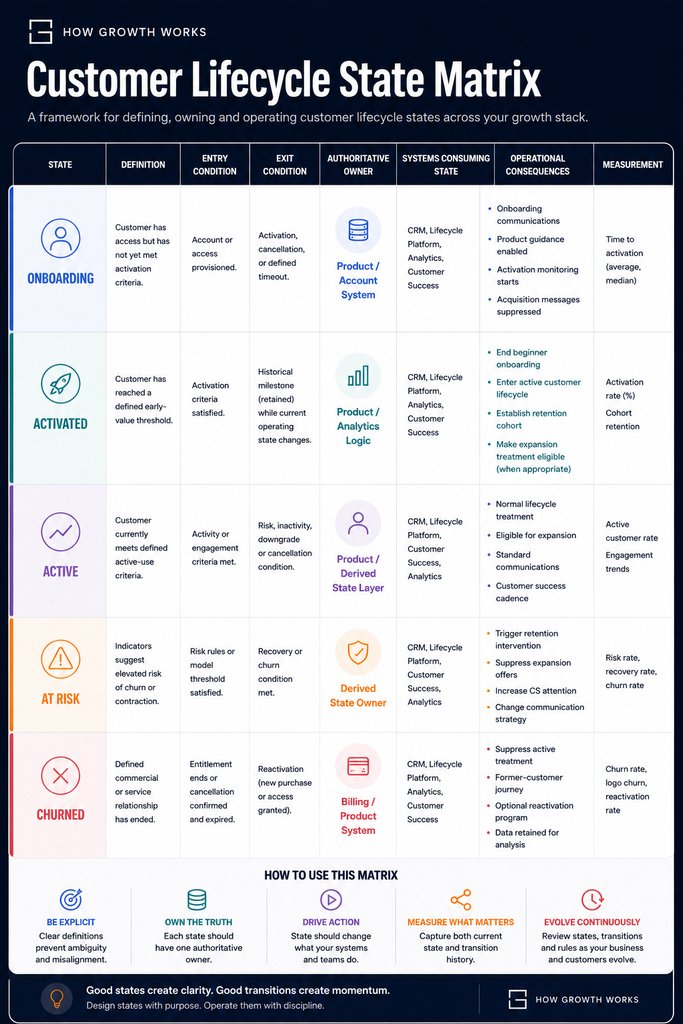
The specific states are illustrative.
The structure is what matters.
It forces the business to make implicit lifecycle assumptions explicit.
From Customer Journey to Operational Logic
Most growth teams already understand the idea of a customer journey.
The harder step is translating that journey into reliable operational logic.
That requires more than drawing arrows between lifecycle stages.
It requires knowing:
what the states mean;
what establishes them;
which entity they describe;
which systems own them;
where they need to move;
what decisions depend on them;
and how changes are preserved for measurement.
That is the difference between having lifecycle marketing and having lifecycle architecture.
The distinction becomes more important as the business grows.
Early on, a founder can compensate for ambiguity manually.
Someone notices that the customer already purchased and removes them from the acquisition campaign.
Someone remembers that a particular account cancelled.
Someone knows that the CRM field is unreliable and checks Stripe instead.
Those workarounds are part of what eventually becomes Stack Debt.
The business begins depending on human knowledge to reconcile systems that do not share a coherent representation of the customer relationship.
At scale, that stops working.
The answer is not necessarily more technology.
It is making the logic underneath the technology explicit.
Growth infrastructure becomes professional not when the company has accumulated more platforms, automations and customer data, but when the business understands how its customer journey, data, systems and decisions fit together.
Customer lifecycle state is one of the places where that understanding becomes operational.
Leave a Reply