
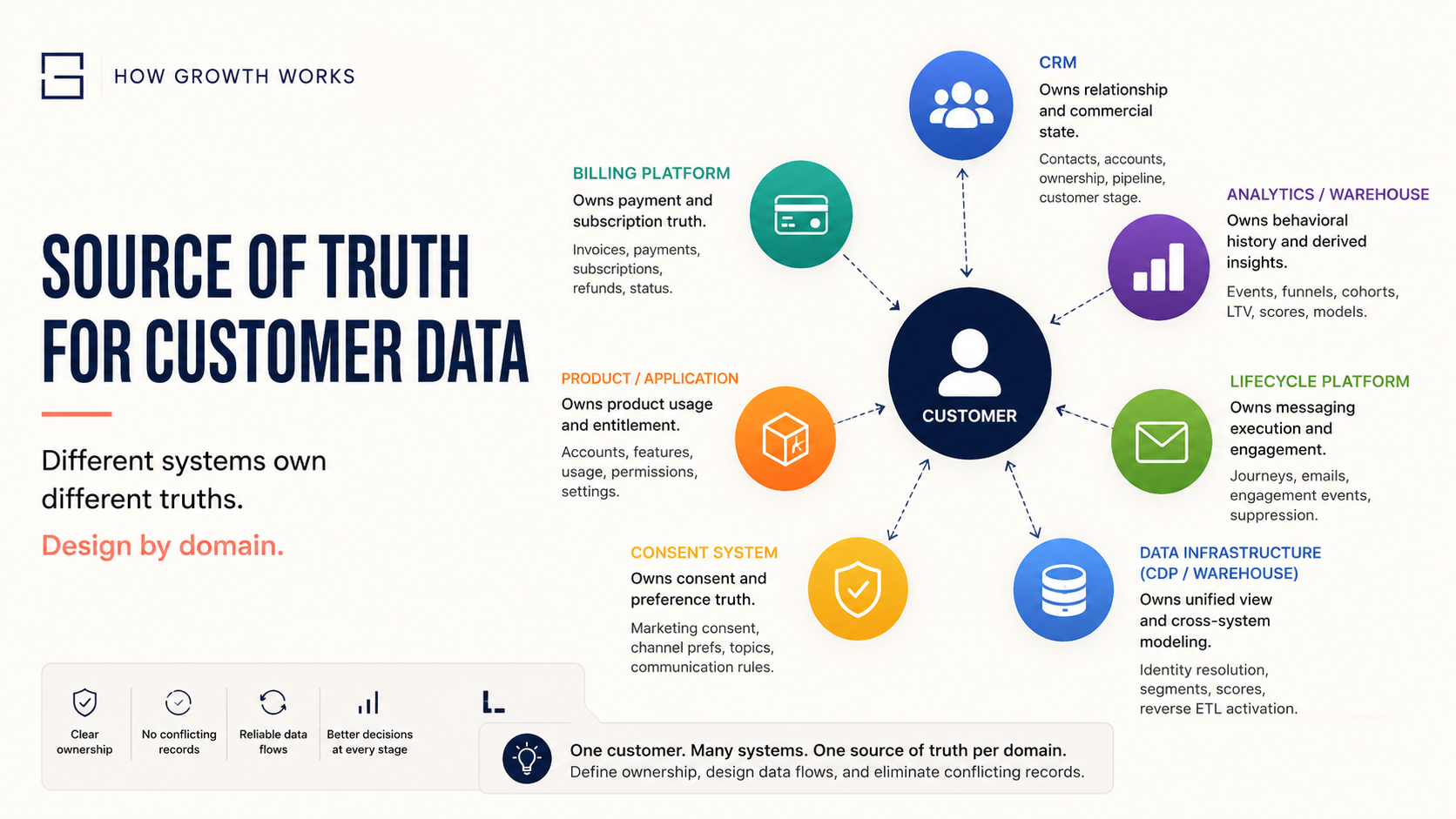
The CRM says Sarah is an active customer.
The billing platform says she cancelled yesterday.
The email platform still has her in an active-customer segment.
The product says her account is enabled, but she has not used it for six months.
Analytics contains two profiles because she browsed anonymously before creating an account.
Customer Success has a spreadsheet where somebody marked her “At Risk” three weeks ago.
Which version is true?
The conventional answer to this kind of problem is:
You need a single source of truth.
It sounds sensible. It is also too simplistic.
A growing digital business rarely has one system that should authoritatively own every fact about a customer.
The system that knows whether Sarah paid is not necessarily the system that knows whether she uses the product.
The system that knows whether she uses the product is not necessarily the system that owns the sales relationship.
And the system containing the richest analytical representation of Sarah may be completely inappropriate for determining whether she should retain access to the product.
The more useful architectural principle is:
There is rarely one source of truth for the customer. There should be one authoritative owner for every customer fact that matters.
That distinction is one of the foundations of coherent customer-data architecture.
The problem with “single source of truth”
The phrase is used constantly in CRM, RevOps and customer-data discussions.
But it can mean several different things.
Sometimes “source of truth” means the system where a record originated.
Sometimes it means the database analysts trust.
Sometimes it means the CRM.
Sometimes it means a warehouse where several systems have been combined.
Sometimes it means a CDP creating a unified customer profile.
These are not necessarily the same thing.
The useful question is not:
Where does everything live?
It is:
When two systems disagree about an important fact, which system should win?
That is a much more precise architectural question.
Suppose billing says a subscription was cancelled at 14:32 yesterday, while the CRM still says:
subscription_status = active
If billing is authoritative for subscription state, the CRM is not another equally valid version of reality.
It contains a stale copy.
That leads to a second principle:
Replication does not transfer authority.
A customer fact can appear in ten systems while still having one authoritative owner.
Start with facts, not platforms
Customer-data architecture often goes wrong because companies ask platform-level questions too early.
Should HubSpot be our source of truth?
Should everything live in Salesforce?
Should the warehouse become the source of truth?
Do we need a CDP?
The better question is:
Source of truth for what?
Break “the customer” into the facts the business actually needs to know.
For example:
- payment succeeded;
- subscription active;
- refund issued;
- trial started;
- account activated;
- product entitlement enabled;
- opportunity qualified;
- marketing consent granted;
- support case open;
- customer at risk;
- lifetime value;
- churn risk.
These facts have different origins and different purposes.
Some are directly observed.
Some are transactional.
Some are manually maintained.
Some are calculated.
And some are interpretations built from several other facts.
That means they should not automatically share the same owner.
System of record vs source of truth
You will also encounter the term system of record.
The terminology is not perfectly standardized, but a useful distinction is:
A system of record is generally an operational system regarded as authoritative for a particular domain of transactions or information.
A source of truth is often used more loosely for whatever system or dataset people believe represents the correct value.
For practical growth infrastructure, I prefer another term:
authoritative owner.
The authoritative owner is the system whose value should prevail when conflicting copies exist elsewhere.
That makes the decision test straightforward.
When CRM, billing and lifecycle systems disagree about subscription status:
Which one has authority over subscription status?
When analytics and product disagree about whether somebody completed activation:
Which one establishes activation?
When CRM and Customer Success disagree about opportunity stage:
Who actually owns that state?
The value of this framing is that it forces the organization to define responsibility rather than merely centralize data.
Customer data is not one thing
It helps to separate customer data into several broad types.
Transactional state
Facts created through commercial transactions:
payment succeeded;
invoice paid;
refund issued;
subscription renewed;
subscription cancelled.
These generally belong close to the system performing or managing the transaction.
Product state
Facts created through product behavior:
account created;
onboarding completed;
feature adopted;
activation reached;
last active date;
entitlement enabled.
These usually originate in the product or application infrastructure.
Commercial state
Facts representing the sales or account relationship:
lead qualified;
opportunity opened;
deal stage;
account owner;
renewal opportunity.
These may reasonably belong in the CRM.
Service state
Facts about the support relationship:
case open;
issue escalated;
resolution status;
customer satisfaction response.
These may originate in the support platform.
Analytical or derived state
Facts calculated from other data:
customer lifetime value;
health score;
engagement score;
churn probability;
product-qualified lead status.
These may legitimately belong in a warehouse, analytics layer or another system responsible for the calculation.
The categories can overlap, but the underlying principle remains useful:
customer data has different origins because it represents different parts of the customer relationship.
Your CRM should not own everything
CRMs occupy a privileged position because they sit near the commercial relationship.
That makes them good places to manage many important facts.
A CRM may reasonably own:
sales qualification;
opportunity stage;
account ownership;
commercial notes;
sales activity;
relationship status.
It may also contain lifecycle information needed by Sales, Marketing or Customer Success.
But containing a field does not automatically make the CRM authoritative for that field.
Suppose the CRM contains:
subscription_status = active
The value was originally copied there from billing.
Yesterday, the customer cancelled.
Billing knows immediately.
The CRM will know once the integration updates it.
Until then, the CRM is stale.
The fact that a salesperson can see and edit the field does not mean the CRM should be allowed to redefine subscription reality.
This is where attempts to make the CRM “the source of truth for everything” can create more problems than they solve.
The CRM may be the best interface for humans while remaining a downstream consumer of product, payment and analytical facts.
Those are different roles.
Payment state is not lifecycle state
Billing provides a particularly useful example because payment state is often confused with customer state.
A successful payment establishes something important:
the customer paid.
It does not necessarily establish:
the customer activated;
the customer is engaged;
the customer is healthy;
the customer should receive expansion messaging;
the customer has retained long-term value.
Likewise, a failed payment does not necessarily mean the broader customer relationship should immediately become “churned.”
There may be retries, grace periods, manual intervention or account-level rules.
A common architectural mistake is to compress several different concepts into a single field such as:
customer_status
That field slowly becomes responsible for billing state, lifecycle state, product access and marketing segmentation.
Eventually nobody knows exactly what “Active” means.
A more reliable architecture separates important states explicitly.
For example:
payment_status = paid
subscription_status = active
product_access = enabled
activation_status = activated
engagement_status = at_risk
lifecycle_stage = retained_customer
Not every business needs this level of detail.
But when different states drive different actions, combining them into one field creates ambiguity.
Product state belongs close to the product
For software and digital products, many of the most important growth signals originate inside the product itself.
Did the user complete onboarding?
Did they invite a teammate?
Did they use the core feature?
Did they reach the activation threshold?
Did they return seven days later?
These facts may be copied into the CRM or lifecycle platform so that other teams can use them.
But again:
Replication does not transfer authority.
If product behavior defines activation, the product or the event infrastructure representing that behavior should usually remain authoritative for the underlying event.
The CRM may contain:
activated = true
because the product told it so.
That makes the CRM useful.
It does not make the CRM the origin of activation truth.
This distinction matters most when systems disagree.
If product says:
activated = true
and CRM says:
activated = false
the resolution should follow the architecture, not whichever interface someone happens to trust more.
Analytics can know a lot without controlling anything
Analytics systems can contain extremely rich representations of customer behavior.
They may know:
what somebody viewed;
which features they used;
how often they returned;
what happened before conversion;
which cohort they belong to;
what behaviors correlate with retention.
They can also maintain sophisticated identity mappings between anonymous activity, logged-in activity and business-defined user IDs.
That makes analytics highly valuable for understanding the customer.
But understanding and operational authority are different things.
An analytics platform may be the best place to answer:
How engaged is this customer?
while being the wrong place to answer:
Is this subscription legally and operationally active?
A useful distinction is:
Some systems help you understand the customer. Other systems determine what is operationally true about the customer.
Sometimes the same platform can contribute to both.
Do not assume it should.
A unified customer profile is not necessarily a golden record
Modern customer-data platforms and warehouse-based architectures make this issue more interesting.
A CDP can ingest information from CRM, billing, web, product and support systems, reconcile identities and create a unified profile.
A warehouse can consolidate much of the same information and provide a central analytical representation.
That can be enormously useful.
It does not automatically mean the unified profile should replace the operational systems underneath it.
A more realistic architecture looks like this:
OPERATIONAL SYSTEMS

Billing   CRM   Product   Support
   \       |       |        /
        CUSTOMER DATA LAYER
                ↓
     Identity / Harmonization
                ↓
       Derived Customer State
                ↓
 Analytics / Segmentation / Activation
The centralized layer may become the best place to understand the customer as a whole.
But the operational systems can still retain authority over the domains they actually manage.
That is not architectural failure.
It is often the correct separation of responsibilities.
Derived state creates a different kind of authority
The warehouse or data layer becomes especially important when the business calculates facts that do not naturally exist anywhere else.
For example:
customer lifetime value;
engagement score;
health score;
likelihood to churn;
product-qualified lead status.
Consider a health score:
Billing → subscription state
Product → usage
Support → unresolved cases
CRM → account tier
              ↓
        Data warehouse
              ↓
        health_score = 42
The warehouse may legitimately become authoritative for health_score.
But it does not become authoritative for the underlying subscription state merely because subscription data passed through it.
This gives us an important distinction between:
source facts
and:
derived facts.
The system responsible for a calculation may own the calculated output while the underlying inputs retain their original authorities.
This is why statements such as:
“The warehouse is our source of truth.”
should always be followed by:
For what?
Ownership and replication are different architectural decisions
Once authority is defined, the business still has to distribute data.
A simplified pattern looks like this:
AUTHORITATIVE OWNER
        ↓
   EVENT / API
        ↓
DATA MOVEMENT LAYER
        ↓
DOWNSTREAM SYSTEMS
        ↓
ACTION / ANALYSIS
The mechanism may be:
an API;
a webhook;
an event stream;
batch synchronization;
an automation platform;
reverse ETL;
a scheduled import.
The mechanism is secondary to the ownership model.
If billing owns subscription state, then copies of subscription status in CRM, email and analytics remain copies.
That means the architecture should define:
where the fact originates;
how it moves;
which systems consume it;
how fresh those copies need to be;
and what happens when the movement fails.
Without those rules, customer-data architecture gradually becomes a collection of competing replicas.
Bidirectional sync deserves suspicion
Bidirectional synchronization can be useful.
It also increases the need for clear conflict rules.
Imagine:
CRM ←→ BillingBoth systems can change subscription state.
A salesperson manually updates the CRM.
That change propagates into billing.
Billing emits another update.
An automation transforms the status.
A stale process writes an older value back.
The systems may still be made reliable, but the architecture is now responsible for resolving conflicting writers.
For important customer state, a clearer default is often directional authority:
BILLING
   ↓
CRM
   ↓
LIFECYCLE
Data can still travel upstream for other purposes.
The important point is that each fact has a defined direction of authority.
If two systems are both allowed to modify the same important fact, you should know exactly how conflicts are resolved.
Otherwise “last update wins” becomes your accidental governance model.
The most recent value is not necessarily the correct value.
Identity resolution is a different problem
Source-of-truth architecture answers:
What is true about this customer?
Identity resolution answers:
Which records represent the same customer?
Those are related but separate problems.
One person may appear as:
CRM contact: 18427
Billing customer: cus_8291
Product user: usr_99181
Analytics user: 74f3...
Email: sarah@example.com
The business needs some way to recognize that those identifiers belong to the same person or account.
Analytics platforms and data systems increasingly support identity-resolution methods for exactly this reason.
But solving identity does not solve authority.
You may correctly determine that all five records represent Sarah and still have three systems disagreeing about whether her subscription is active.
Conversely, you may have perfect ownership rules while failing to recognize that two profiles represent the same human.
The architecture therefore needs to answer two independent questions:
Who is this?
and:
What is true about them?
Identity resolution handles the first.
Authoritative ownership handles the second.
Build a Source of Truth Matrix
The practical solution does not require a large data-governance program.
Start with the business facts that actually change customer or company behavior.
Create a simple matrix:
| Business fact | Authoritative owner | Consumers | Update mechanism | Acceptable delay | Failure consequence | Business owner |
|---|---|---|---|---|---|---|
| Payment succeeded | Billing | Product, CRM, analytics | Webhook/API | Seconds/minutes | Customer not provisioned | Finance/Product |
| Subscription status | Billing | Product, CRM, lifecycle | Webhook | Near real-time | Wrong access/messaging | RevOps |
| Product activation | Product | CRM, lifecycle, analytics | Event/API | Minutes | Wrong onboarding | Product |
| Opportunity stage | CRM | Forecasting, analytics | API | Hours | Forecast errors | Sales |
| Support status | Support | CRM, analytics | API/sync | Hours | Service inconsistency | Support |
| Health score | Data layer | CRM, lifecycle | Transformation/sync | Daily | Mistargeting | Customer Success |
The values are examples.
Your architecture will differ.
The important part is the method.
For every material fact, answer seven questions.
1. What exactly is the fact?
Avoid vague concepts where possible.
customer_status is rarely precise enough if several important processes depend on it.
2. Where is the fact created?
What event or process establishes that something changed?
3. Which system is authoritative?
If multiple versions exist, which one wins?
4. Which systems actually need a copy?
Do not replicate information simply because an integration makes it easy.
5. How fresh must the copy be?
Payment entitlement may need seconds.
A calculated health score may tolerate a daily update.
6. What happens when systems disagree?
Define the conflict rule before the conflict occurs.
7. Who owns the definition?
Technical ownership is not enough.
Somebody in the business should understand what the fact means and why it matters.
Design for disagreement, not permanent perfection
Once data exists in several systems, copies will eventually diverge.
An integration fails.
An event arrives late.
A webhook is processed twice.
An operator manually edits a downstream field.
An old import contains stale information.
An account is duplicated.
A credential expires.
A source system is temporarily unavailable.
Good architecture assumes these things can happen.
For important state:
preserve source identifiers;
retain timestamps where they matter;
monitor synchronization failures;
restrict downstream writes where appropriate;
make critical integrations observable;
define reconciliation rules.
Do not allow correctness to depend entirely on every system remaining perfectly synchronized forever.
That is unrealistic.
The objective is not preventing all disagreement.
It is making disagreements understandable and recoverable.
AI makes authority more important
Now introduce an AI agent into the same architecture.
The agent sees:
CRM: Active Customer
Billing: Cancelled
Product: Dormant
Support: Open Escalation
What should it do?
Send a retention offer?
Disable access?
Suppress marketing?
Ask for payment?
Escalate to a human?
The agent cannot answer correctly merely because it can see all four systems.
More context is not the same thing as trustworthy context.
It needs to know:
what each field means;
where it came from;
which system has authority;
how fresh the data is;
what actions it is allowed to take.
That leads to a broader HGW principle:
AI increases the value of knowing not only what a customer fact says, but where it came from and whether that source is authoritative.
This extends another principle:
AI readiness is partly architecture readiness.
Giving an agent access to fragmented customer data does not create a coherent customer model.
It gives the agent faster access to ambiguity.
You probably do not need one source of truth
The appeal of a single source of truth is understandable.
One customer.
One profile.
One place containing everything.
But real digital businesses operate across billing systems, products, CRMs, support platforms, lifecycle tools and analytical infrastructure.
Different systems observe different parts of the relationship.
Trying to force every fact into one application can introduce more synchronization, coupling and artificial centralization than the business actually needs.
A better objective is coherent distributed authority.
Know which system owns payment state.
Know which system owns product state.
Know which system owns commercial state.
Know which system calculates derived state.
Know how identities connect those systems.
Know which applications contain downstream copies.
Know how quickly those copies need to update.
Know what happens when they disagree.
Then centralize where centralization creates genuine value.
A coherent customer-data architecture does not require every system to contain identical data.
It requires something simpler and more important:
For every customer fact that matters, the business knows what to believe.
Customer-data authority is one part of a wider architecture. If you want to step back and examine how CRM, automation, analytics, integrations and customer journeys fit together, start with Your Business Has Outgrown Its Tech Stack. Now What? Or use How to Audit Your Growth Tech Stack to inspect the infrastructure you already have.
Leave a Reply