
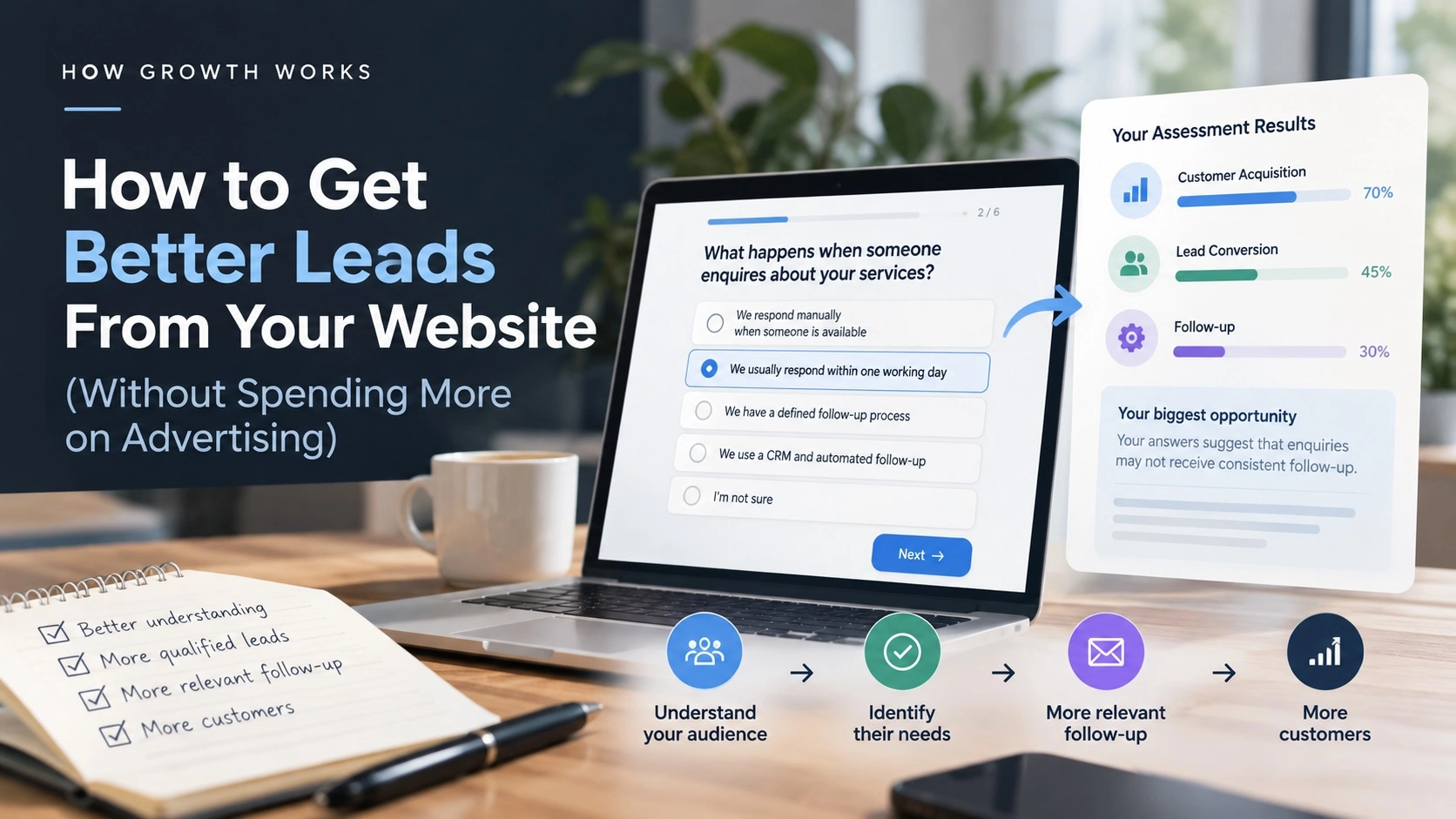
If you’re wondering how to get better leads from your website, the answer isn’t necessarily more advertising. Sometimes the biggest opportunity is understanding the visitors you’re already attracting.
Affiliate disclosure: This article contains affiliate links. If you sign up or purchase through them, How Growth Works may earn a commission at no additional cost to you. Recommendations are based on practical experience and independent editorial judgment.
I’ve worked with enough marketing funnels to know that getting more leads isn’t always the problem.
Sometimes the bigger problem is that a business doesn’t know enough about the leads it’s already generating.
Someone downloads a guide, joins an email list or fills out a contact form.
Great. But what do we actually know about them?
What are they trying to achieve? What problem are they struggling with? Are they a good fit for what the business offers?
And perhaps most importantly, what should happen next?
I’ve seen how easy it is to build marketing systems around collecting contact details without giving enough thought to what those details actually tell us.
That’s one reason I’ve become interested in interactive assessments and lead qualification scorecards.
I’ve recently worked with ScoreApp to build an interactive assessment for a client. What interests me isn’t simply the ability to create a quiz.
It’s the opportunity to understand potential customers before deciding how to communicate with them.
And for many small businesses, I think that’s worth exploring before spending more money on advertising.
Why more leads aren’t always better
Imagine two marketing campaigns.
Campaign A generates 100 enquiries.
Campaign B generates 30.
At first glance, Campaign A looks like the winner.
But suppose only ten of Campaign A’s enquiries are suitable customers, while 15 of Campaign B’s enquiries are a strong match for the business.
Suddenly, the picture changes.
Of course, we’d still need to consider acquisition costs, conversion rates and customer value before deciding which campaign performed better.
But the example illustrates something important.
Lead volume and lead quality are not the same thing.
A website visitor is someone who has shown some level of interest.
A lead is someone whose contact information you’ve captured.
A qualified lead is someone who appears to have a relevant need and fits the type of customer your business can serve.
A genuine sales opportunity is someone with a realistic possibility of becoming a customer.
And a paying customer is where the commercial relationship actually begins.
These distinctions matter because businesses often optimize for the easiest number to increase.
More traffic. More subscribers. More enquiries.
But none of those automatically means more revenue.
When I’m looking at a lead generation problem, I want to understand the journey from initial interest to a successful customer.
That starts with knowing who the business is actually trying to attract.
It’s the same principle behind building a lead qualification system around your ideal customer profile: qualification should reflect the customers a business can genuinely help, not just how interested someone appears to be.
The problem with traditional lead magnets
There’s nothing inherently wrong with offering a downloadable guide, free resource or newsletter subscription.
I’ve used these approaches extensively.
They can work very well, particularly when the resource addresses a specific problem and attracts the right audience.
But they have a limitation.
Someone downloads a PDF titled 10 Ways to Improve Your Marketing.
What have we learned?
We know they’re interested enough in marketing to download a guide.
That’s about it.
We don’t know whether they run a business, how large it is, what they’re struggling with or whether they’re looking for help.
The usual response is to put them into an email sequence.
Perhaps they receive five educational emails followed by an invitation to book a consultation.
But we’re making assumptions about what they need.
A business owner struggling to generate enquiries receives the same messages as someone generating plenty of enquiries but failing to convert them.
Those are two different problems.
And they probably require different solutions.
This is where I think interactive assessments become interesting.
What if your lead magnet helped you understand the customer?
Instead of offering everyone the same downloadable guide, imagine offering a short assessment.
For example:
How Effective Is Your Small Business Marketing?
The visitor answers a handful of questions:
- Where do most of your customers currently come from?
- Do you know how many website visitors become enquiries?
- What happens when someone contacts your business?
- Do you have a system for following up?
- Which part of marketing feels most difficult?
- What would you most like to improve?
At the end, they receive a personalized assessment.
Perhaps it identifies three areas:
Customer acquisition: How effectively the business attracts potential customers.
Lead conversion: How well it turns interest into enquiries and sales.
Follow-up: Whether potential customers receive appropriate communication after their initial interaction.
The visitor gets something useful.
They understand where their marketing may be underperforming.
Meanwhile, the business learns something meaningful about the person completing the assessment.
If someone scores well on acquisition but poorly on follow-up, there’s little point immediately selling them more advertising.
Their immediate opportunity may be improving how they handle existing enquiries.
That’s a much more useful starting point for a conversation.
The important distinction is that the assessment should create value for both sides.
It shouldn’t simply disguise a sales questionnaire as a quiz.
How to Get Better Leads From Your Website Using Interactive Assessments
I’ve recently been using ScoreApp to build an interactive assessment for a client in the education and learning space.
The objective wasn’t simply to create another lead magnet.
It was to give prospective customers an engaging way to interact with the business while creating opportunities for more relevant communication afterwards.
What became clear during the process was that the technology is only one part of the work.
Before building the assessment, I needed to think about the customer journey.
Who is this for?
Why would someone want to complete it?
What would make the result genuinely interesting?
What information would help the business understand that person better?
And what should happen after they finish?
Those questions are more important than choosing a template.
One of the advantages of ScoreApp is that it provides the infrastructure for building interactive assessments, capturing responses, assigning scores and presenting personalized results.
Its platform also includes AI-assisted quiz creation, landing pages, scoring, segmentation and CRM connectivity, although the available functionality varies by plan.
That removes much of the technical work involved in creating an assessment from scratch.
But it doesn’t remove the need to design a good assessment.
You still need to understand your audience.
You still need to ask useful questions.
You still need to decide what the results mean.
And you still need a sensible plan for what happens afterwards.
In my experience, that’s where much of the real Growth work sits.
How I’d build a lead qualification assessment for a small business
If I were helping a small business improve its website lead generation, I wouldn’t start by opening ScoreApp.
I’d start with the commercial problem.
Here’s the process I’d follow.
1. Define who you’re trying to attract
Before creating questions, get clear about the type of customer your business serves best.
Let’s imagine a small consultancy helping businesses improve their marketing.
Its ideal customers might be established service businesses with five to twenty employees.
They already have customers and some marketing activity, but struggle to generate consistent enquiries or understand which activities produce revenue.
That tells us something useful.
The assessment shouldn’t be designed primarily for people who haven’t started a business.
Nor should it assume every respondent has a sophisticated marketing department.
It should speak to the problems of the intended audience.
I would also identify what makes someone a poor fit.
This doesn’t mean excluding everyone else from receiving useful information.
It means understanding which enquiries deserve commercial follow-up.
2. Promise one clear outcome
People don’t complete assessments because a business wants more customer data.
They complete them because they expect to learn something.
The assessment needs a clear promise.
For example:
Find Out What’s Holding Back Your Small Business Marketing
That’s more compelling than:
Complete Our Marketing Qualification Questionnaire.
I’d also explain what the person will receive.
Perhaps a personalized score, an explanation of their biggest potential weakness and three practical recommendations.
The result needs to justify the time required.
3. Ask questions that reveal something meaningful
This is where I’d spend considerable time.
Every question should serve at least one of two purposes:
- Help the visitor understand their situation.
- Help the business provide a more relevant next step.
Ideally, it does both.
For example:
What happens when someone enquires about your services?
Possible answers:
- We respond manually when someone is available.
- We usually respond within one working day.
- We have a defined follow-up process.
- We use a CRM and automated follow-up.
- I’m not sure.
That question reveals something about the business’s sales process.
It also encourages the respondent to consider whether they’re handling enquiries effectively.
I’d avoid unnecessary questions about revenue, budgets or personal information unless they’re genuinely needed.
Every additional question introduces friction.
And sensitive questions can reduce trust.
4. Make the results genuinely useful
This is probably the most important part.
A weak assessment tells everyone some variation of:
Your marketing could be better. Book a call to find out how.
That’s not particularly useful.
A better assessment identifies specific areas of strength and weakness.
For example:
Your strongest area: Customer Acquisition
You’re generating interest through several channels.
Your biggest opportunity: Lead Follow-Up
Your answers suggest that enquiries may not receive consistent follow-up.
Recommended next step
Document what happens after someone contacts your business and introduce a simple follow-up process.
That gives the visitor something practical.
It also creates a natural opportunity for the business to offer further help.
I would be careful not to present a short self-reported assessment as a definitive diagnosis. The result should reflect what the respondent has told us, acknowledge uncertainty where appropriate and avoid making claims the questions cannot support.
5. Match the next step to the result
Not everyone completing an assessment should receive the same invitation.
Someone with an urgent problem and a clear need might benefit from a consultation.
Someone still exploring their options might prefer a useful guide.
Someone whose business isn’t a suitable match might be better served by a different resource.
The goal is relevance.
For a small business, this doesn’t need to become complicated.
Three broad outcomes may be enough:
| Assessment outcome | Suggested next step |
|---|---|
| Strong fit and ready for help | Invite them to book a consultation |
| Potential fit but still exploring | Offer relevant educational content |
| Not currently a suitable fit | Provide useful guidance without aggressive sales follow-up |
I would start simple and refine the approach based on what actually happens.
6. Connect the assessment to your email marketing or CRM
This is where the assessment becomes part of a wider Growth system.
Imagine someone completes the assessment and identifies follow-up as their biggest problem.
If the business uses an email marketing platform, it could send them a short series of useful resources about improving enquiry handling.
Someone struggling with customer acquisition could receive different material.
Someone ready to discuss a solution could be invited to book a call.
The important point is that the assessment results inform what happens next.
They shouldn’t disappear into a spreadsheet nobody looks at.
ScoreApp supports CRM connectivity and integrations, but I’d verify the specific integration and required plan before designing the workflow around it.
I’d also make sure people have given appropriate consent for marketing communications.
Completing an assessment shouldn’t automatically mean someone has agreed to receive every promotional email a business wants to send.
For businesses wanting to understand the wider architecture, I’ve explored how this works in How Customer Data Should Move Through Your Growth Stack.
But most small businesses don’t need a sophisticated customer data platform.
They need a reliable way to capture relevant information and use it appropriately.
7. Measure whether it actually improves results
Once the assessment is live, the work isn’t finished.
Now we need to understand whether it’s helping.
I’d start with a few straightforward questions.
How many people see the assessment?
How many start it?
How many finish?
How many provide their contact details?
How many are suitable prospects?
How many book a consultation or take another meaningful next step?
And eventually, how many become customers?
I’d also compare the assessment with whatever the business was doing previously.
If a simple contact form was already generating good enquiries, the assessment needs to demonstrate that it adds value.
Otherwise, we’ve just introduced another step into the customer journey.
Where ScoreApp fits — and what it costs
ScoreApp is designed for businesses that want to create interactive assessments, quizzes and scorecards without building the underlying technology themselves.
Its main appeal is that several components of the process sit within one platform.
You can create landing pages, build questions, score responses, present personalized results and capture lead information.
The platform also offers AI-assisted building tools, which may help speed up the initial creation process.
For a small business, I think that’s useful.
Building the same experience manually could involve a form builder, scoring logic, landing page software, a results page and several integrations.
ScoreApp brings much of that functionality together.
However, it’s worth understanding the pricing before committing.
ScoreApp pricing
The following prices are indicative and should be checked against the current plans before purchasing.
| Plan | Monthly price | Included responses |
|---|---|---|
| Free | $0 | 10 per month |
| Starter | $39 | 100 per month |
| Business | $99 | 1,000 per month |
| Pro | $149 | 3,000 per month |
The free plan supports one live scorecard. Starter supports three, Business ten and Pro thirty.
Annual billing discounts may be available, and prices can vary by currency, taxes and changes to the plans.
For someone testing their first assessment, I’d start with the free plan.
There’s little reason to pay for advanced functionality before establishing whether the assessment is useful.
The Starter plan may be sufficient for a small business running a relatively simple assessment.
Business and Pro become more relevant when response volume, branding requirements, reporting or experimentation needs justify the additional expense.
I wouldn’t automatically recommend the most expensive plan.
The right plan is the least expensive one that reliably supports the customer journey you’re trying to create.
Try ScoreApp
If you’re considering an interactive assessment for your business, ScoreApp is one of the platforms I’d recommend exploring.
I’ve used it to build an assessment, and I think it’s particularly relevant for consultants, coaches, education businesses and service providers that benefit from understanding prospective customers before recommending a solution.
Explore ScoreApp and start building your first assessment
When I wouldn’t recommend a quiz
Despite the potential benefits, I don’t think every small business needs an interactive assessment.
Sometimes a quiz introduces unnecessary friction.
Imagine someone searching for a local electrician.
They have an urgent problem.
They want to know whether the electrician can help, how quickly they can arrive and approximately what it will cost.
Asking them to complete a ten-question assessment would probably be a terrible idea.
A clear contact form or telephone number is much more appropriate.
The same principle applies to other businesses.
If customers already know exactly what they need, an assessment may simply delay the conversion.
I would also be cautious when:
- The business has very little website traffic.
- The offer is simple and requires little qualification.
- The assessment cannot provide genuinely useful results.
- The business has no capacity to follow up with enquiries.
- The questions require information visitors may not want to share.
- The business hasn’t established a clear reason for someone to choose it.
That last point matters.
A quiz won’t fix an unclear proposition.
It won’t make an unsuitable product attractive.
And it won’t automatically generate traffic.
An assessment is a way to engage and understand an existing audience.
It isn’t a substitute for having something people want.
Don’t introduce a quiz because quiz software exists. Introduce one because it improves a specific part of the customer journey.
What I’d actually measure
One mistake I would avoid is judging the assessment purely by the number of completions.
Imagine an assessment receives 500 visitors.
Of those, 200 start it and 120 finish.
That gives us a 60% completion rate among people who started.
Useful information.
But what if only five respondents are suitable customers?
And what if none of them takes the next step?
We haven’t necessarily improved lead generation.
We’ve created an interactive experience that people complete.
Those aren’t the same thing.
I’d measure performance across three levels.
1. Engagement
Are people interested enough to begin and complete the assessment?
This helps identify problems with the headline, questions, length or user experience.
2. Qualification
Are we attracting people who resemble the customers the business wants to serve?
Are their answers revealing useful information?
Are we identifying meaningful differences between respondents?
3. Commercial outcomes
Are suitable prospects taking the next step?
Are consultations being booked?
Are those conversations progressing?
Are customers being acquired?
And is the revenue generated sufficient to justify the cost?
This is where the real evaluation happens.
I’d also be careful about attribution.
Someone might complete an assessment, read several emails and return weeks later through another channel.
That doesn’t necessarily mean the assessment caused the sale.
But it may have contributed to the journey.
The objective is to build a sufficiently reliable picture of what is happening, rather than claiming every conversion for whichever tool we happen to be evaluating.
I’ve explored this distinction in Why Your Growth Analytics Cannot Be Trusted.
For a small business, the practical takeaway is simple: measure the outcomes that matter, and understand what your numbers can and cannot tell you.
The bigger opportunity is better follow-up
One thing I’ve noticed throughout my work with marketing systems is how much attention businesses give to attracting potential customers compared with what happens afterwards.
They spend money on advertising.
They improve their websites.
They create content.
They work on SEO.
They build social media audiences.
But when someone finally expresses interest, the follow-up can be surprisingly generic.
Everyone receives the same emails.
Or nobody follows up consistently.
Or the information collected during the enquiry process never reaches the person responsible for the next conversation.
This is where I think interactive assessments can create value beyond lead generation.
They can help a business understand what someone needs before deciding what to communicate.
For example, imagine a consultancy offering three services:
- Marketing strategy.
- CRM and automation.
- Customer retention.
Someone completing an assessment might reveal that they already generate plenty of enquiries but struggle to manage follow-up.
Why send them a generic email about generating more traffic?
A more relevant next step would be information about improving their CRM or enquiry-handling process.
Another respondent might have a strong follow-up process but very little qualified traffic.
Their needs are different.
This doesn’t require an elaborate AI agent or complicated automation architecture.
Often, a few well-designed segments and simple email sequences are enough.
The important part is knowing where someone is in their customer journey and what should happen next.
And when the next step is predictable, conventional marketing automation is usually perfectly capable of handling it.
The objective isn’t to automate everything.
It’s to make the customer experience more relevant without creating unnecessary work for the business.
Start with one assessment, not an entire funnel
If you’re a small-business owner considering this approach, I wouldn’t recommend spending weeks building an elaborate lead generation system.
I’d start with one assessment.
Choose one audience.
Identify one meaningful problem.
Create a short set of questions.
Deliver a genuinely useful result.
Offer one relevant next step.
Then measure what happens.
You don’t need five different quizzes, twelve audience segments and twenty automated email sequences.
You need to establish whether the approach creates value.
If people aren’t completing the assessment, investigate why.
If they’re completing it but aren’t suitable customers, revisit the audience and proposition.
If suitable prospects are completing it but not taking the next step, examine the results and follow-up.
And if the assessment starts generating valuable conversations, you have evidence to justify improving the system.
That’s how I’d approach it.
Build something useful.
Measure it.
Learn.
Then improve it.
My final view: better leads begin with better understanding
I don’t think most small businesses need more marketing complexity.
They need to understand which activities actually help them attract and convert the right customers.
Sometimes that means generating more traffic.
Sometimes it means improving the website.
Sometimes it means responding to enquiries faster.
And sometimes it means learning more about potential customers before deciding what to offer them.
That’s where interactive assessments can be useful.
My experience building with ScoreApp has reinforced something I’ve believed for a long time: the technology matters, but the customer journey matters more.
A well-designed assessment can help someone understand their own needs while giving the business information to provide a more relevant next step.
But the assessment itself isn’t the strategy.
The strategy is understanding who you’re trying to help, what they need and how to create a useful relationship from that first interaction.
The objective isn’t to collect more email addresses. It’s to create more useful conversations with the right potential customers.
Need Help Building Your Own Lead Qualification Assessment?
I’ve worked with ScoreApp to build interactive assessments and understand how they fit into a wider lead generation and marketing automation strategy.
If you’d like help designing and setting up an assessment for your business, I offer practical, tailored implementation support.
Email stephen@howgrowthworks.com to discuss your project.
Leave a Reply