
I’ve spent a lot of time recently thinking about where AI agents actually belong in modern Growth work.
I’m interested in the technology, but I’m skeptical of the idea that every workflow suddenly needs an agent.
If a process is predictable, conventional automation is usually easier to understand, cheaper to run and more reliable.
OpenAI’s new dots have made me reconsider part of that mental model.
Not because I suddenly want an AI agent running every Growth workflow.
Almost the opposite.
Dots made me wonder whether I’ve sometimes been thinking about AI agents at the wrong architectural level.
What OpenAI actually announced
OpenAI describes dots as always-on AI agents that can maintain context, work toward goals between conversations and operate through connected apps.
Each dot has its own cloud computer. It can work across multiple projects, remember context from ongoing work and connected sources, run scheduled tasks and perform what OpenAI calls “proactive research” in the background.
Importantly, that does not mean unrestricted autonomy.
OpenAI says proactive background research uses read-only tools. Actions are governed by permissions, Custom Rules, approvals and safety checks. Some consequential actions require approval or have to be handed back to the user entirely. OpenAI also explicitly warns that dots can make mistakes.
The product has only just been announced, so I’m not going to pretend we know how well this model works across messy real-world Growth environments.
But the architecture is interesting.
Because it changes the question from:
What tasks should I give an AI agent?
to:
What happens when an AI system maintains context around what the team is actually trying to accomplish?
That is a much more interesting Growth problem.
My previous model was relatively simple
My working model for AI in Growth has generally looked something like this. It’s the same distinction I explored in AI Agents vs Automation: What Should Actually Run Your Growth Stack?: interpretation and execution are different problems, and adding AI to a workflow does not automatically make it better.
Human judgment
↓
Growth systems
↓
Deterministic automation
↓
AI where interpretation is genuinely useful
The principle underneath it is straightforward:
Use deterministic automation when the answer is knowable. Use AI when interpretation is genuinely useful. Keep humans responsible for consequential decisions.
I still believe that.
If somebody becomes a customer, I probably don’t need an AI agent deciding whether they should leave the prospect sequence and enter onboarding.
We know what happened.
Update the lifecycle state. Trigger the appropriate workflow. Suppress the irrelevant messages.
This is exactly why I think customer lifecycle states need to be explicit. Once the business knows what state a customer is in and what should happen because of it, predictable execution should remain predictable.
That’s an automation problem.
Adding an agent might make the architecture less reliable rather than more intelligent.
But a lot of Growth work isn’t that clean.
Which leads to what dots made me reconsider.
Maybe the agent shouldn’t live inside the workflow
I’ve often thought about AI agents as another component in the Growth stack.
CRM. Analytics. Customer data. Lifecycle platform. Automation. Personalization. Agent.
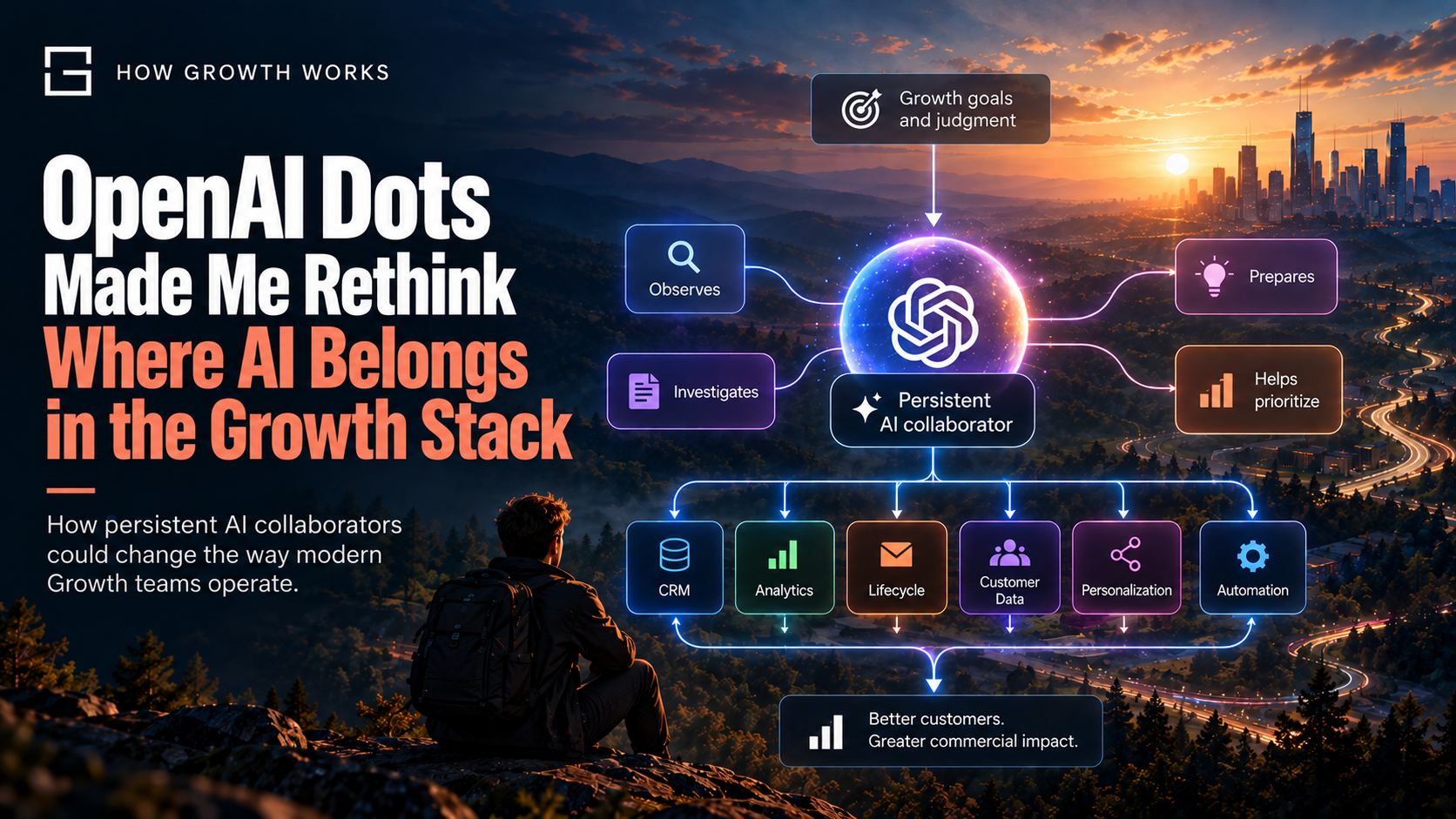
But persistent agents suggest another model:
Human goals + judgment
↓
Persistent AI collaborator
↓
CRM | Analytics | Lifecycle | Customer Data | Research | Experimentation | Personalization | Automation
↓
Individual workflows and actions
In this model, AI doesn’t necessarily replace the systems underneath it.
It sits across some of them.
It maintains context. It investigates. It notices changes. It prepares work. It connects information that would otherwise remain fragmented. Where appropriate, it might eventually act through existing systems within defined boundaries.
To be clear, I’m describing the architecture that dots make me think about—not claiming that today’s product can walk into an arbitrary Growth stack and do all of this reliably.
But consider what I would actually want from such a system.
I don’t want more leads. I want to understand qualified demand.
Imagine I’m responsible for increasing qualified pipeline.
A campaign generates 300 leads.
That’s useful information, but it isn’t enough.
I want to know which of those leads actually resemble our ideal customer profile.
Which channels produced them?
What problems brought them to us?
Which messages attracted them?
Which became genuine opportunities?
Which bought?
And eventually, which became successful customers?
Those answers often live in different systems.
Campaign data tells me one thing. The CRM tells me another. Sales conversations add context. Product or customer data tells me what happened after conversion.
A persistent AI collaborator becomes interesting if it can maintain enough context across those signals to help identify what actually matters.
I don’t merely want:
Campaign A generated 40% more leads.
I want to discover something more commercially useful:
Campaign B generated fewer leads, but a much higher proportion matched our ICP and progressed into meaningful opportunities.
That’s a completely different conclusion.
The important metric isn’t always volume.
It’s whether we’re attracting the right customers.
That is also why I think lead qualification needs to connect back to the ICP rather than becoming an arbitrary score inside a CRM. A good qualification system should help the business distinguish activity from genuine commercial demand.
Growth doesn’t need another 50 experiment ideas
This may be where persistent AI gets particularly useful.
Most Growth teams don’t have an idea shortage.
Give a capable model a website, some analytics and five minutes and it can produce dozens of experiments.
That’s rarely the bottleneck.
The harder questions are:
What have we already tried?
Why did we try it?
What happened?
What did we actually learn?
Which assumptions remain unresolved?
And, given everything else competing for attention, what deserves to be tested next?
Experiments lose value when their learning disappears into old documents, dashboards, Slack threads and people’s memories.
A persistent collaborator could potentially maintain that history.
Then AI stops being an experiment generator and becomes something closer to institutional memory.
That is much more valuable.
Because Growth isn’t a competition to produce the most ideas.
It’s a process of reducing uncertainty without repeatedly forgetting what you’ve already learned.
I don’t want an AI chatbot sitting on top of a dashboard
The obvious AI analytics use case is conversational querying:
“Why did conversion fall last week?”
Useful, perhaps.
But I think the more interesting model begins before I ask the question.
Something changed.
The system notices.
Then it starts investigating:
Where did the change occur?
Which segments were affected?
Did traffic composition change?
Did a campaign launch?
Did tracking change?
Did the product change?
What evidence supports each explanation?
What alternative explanations exist?
What don’t we know?
What should we investigate or test next?
That could save a lot of attention.
But there is an important constraint.
AI cannot reason its way out of bad measurement.
If identity resolution is broken, events are inconsistent or teams use different definitions of “activated customer,” the model may simply produce a convincing explanation from unreliable evidence.
That’s why analytics trust matters even more in an agentic environment. If instrumentation, identity, definitions or attribution are unreliable, AI doesn’t repair the evidence underneath them. It can simply make unreliable evidence easier to interrogate.
A confident answer based on bad instrumentation is still a bad answer.
Growth is a lifecycle, not a collection of channels
I’d also want a persistent collaborator to understand the customer relationship across the complete lifecycle:
Acquisition → Qualification → Conversion → Onboarding → Activation → Engagement → Retention → Expansion
Those stages are usually distributed across teams and systems.
That is partly a customer-journey problem and partly a customer data architecture problem. The relevant customer context has to move between systems without every platform becoming an alternative version of the truth.
Otherwise strange situations emerge.
Acquisition can hit its target while Sales complains about lead quality.
Conversion can improve while activation deteriorates.
A customer can be highly engaged in the product while still receiving beginner onboarding.
A high-value customer can start disengaging without anybody noticing because retention signals sit somewhere else.
A campaign can successfully acquire customers by creating expectations the product experience doesn’t fulfill.
Each local metric can look reasonable while the overall customer journey is getting worse.
A useful AI collaborator would help connect those signals.
Not because I want it autonomously redesigning the lifecycle.
Because I want it helping the team notice that two apparently separate problems may actually be one problem.
Personalization becomes more interesting in context
The same applies to personalization.
A recommendation system might answer:
What is most relevant to this customer right now?
A lifecycle system might answer:
Where is this customer in their relationship with us?
CRM and customer data tell us what we know about them.
Analytics tells us what they’ve done.
These are related questions, but they’re not identical.
A persistent AI layer could potentially reason across those contexts and identify opportunities that individual systems cannot see.
Perhaps a high-value customer is repeatedly engaging with one product category but receiving lifecycle communications based on an outdated segment.
Or perhaps a recommendation system is correctly optimizing for immediate engagement while the broader lifecycle suggests that the customer needs something completely different to reach activation.
Spotting those mismatches is one thing.
Automatically rewriting recommendation logic or changing lifecycle rules is another.
I would give AI much more freedom over the first than the second.
That distinction matters.
The interesting opportunity isn’t simply adding AI to personalization. It’s giving an intelligent system enough context to understand how personalization relates to the wider customer journey.
The boring Growth work might be where this gets really valuable
There is another category of work that receives much less attention than autonomous campaigns and AI-generated creative.
Operational entropy.
Documentation becomes stale.
Lifecycle states drift.
Handoffs break.
Automations stop matching the customer journey.
An experiment gets launched but nobody documents the conclusion.
A dashboard slowly loses trust.
Someone identifies a problem in a meeting and six weeks later discovers nobody followed it through.
A change in one system quietly breaks assumptions somewhere else.
No individual failure destroys Growth performance.
The system just becomes progressively harder to operate.
A persistent collaborator that notices those gaps could be extremely valuable.
Not glamorous.
Useful.
I would not give it unlimited autonomy
This is where I remain cautious.
My starting hierarchy would be:
Observe
Maintain context across relevant information.
Investigate
Find anomalies, patterns and possible explanations.
Recommend
Tell me what deserves attention and why.
Prepare
Prepare the analysis, experiment, communication or proposed change.
Act
Execute defined actions inside explicit boundaries.
Commit
Keep consequential decisions with humans.
I would initially be much more comfortable allowing AI to observe, investigate, recommend and prepare than giving it authority to spend significant budgets, change pricing, make consequential customer decisions, alter critical lifecycle logic, publish externally or change important infrastructure.
That boundary can move.
A low-risk, repeatable action that has performed reliably hundreds of times doesn’t necessarily need the same oversight forever.
But autonomy should be earned through demonstrated reliability.
It shouldn’t be granted simply because a system is technically capable of clicking the button.
A better Human + AI Growth loop
The operating model I’m increasingly interested in looks like this:
Observe → Investigate → Prepare → Decide → Execute → Learn
AI observes relevant systems and maintains context.
AI investigates changes, patterns and possible explanations.
AI prepares analysis and proposed actions.
Humans decide what matters, apply commercial judgment and resolve ambiguity.
Existing systems execute predictable work.
Then the outcomes feed back into the next decision.
The exact boundary will change by task.
Some low-risk actions will eventually move toward bounded autonomy.
Others should probably remain human decisions for a long time.
The point isn’t to maximize autonomy.
It’s to allocate judgment intelligently.
And when the decision is already known, well-designed deterministic automation should still do what it does best: execute predictable decisions consistently.
Attention may be the real bottleneck
This is the part of dots that interests me most.
A Growth team has almost unlimited possible work.
Another landing page.
Another campaign.
Another experiment.
Another segment.
Another personalization rule.
Another automation.
Another dashboard investigation.
Another piece of content.
Another product improvement.
AI makes generating all of those things cheaper.
That doesn’t necessarily make the team better.
It could make the attention problem worse.
The scarce resource is increasingly the ability to decide:
What deserves our attention now, and why?
Answering that well requires more than intelligence in the abstract.
It requires business context.
Customer context.
Reliable data.
Experiment history.
Commercial objectives.
Knowledge of previous decisions.
And an understanding of what the team is deliberately not doing.
Persistent context could therefore matter less because it allows AI to do more work and more because it helps AI understand which work may actually matter.
That is a fundamentally different value proposition.
The best AI Growth system may not be the one generating the greatest volume of output.
It may be the one preventing the team from spending three weeks solving the wrong problem.
AI doesn’t fix bad Growth infrastructure
There is an obvious counterargument to all of this.
Put an intelligent agent across duplicate CRM records, inconsistent lifecycle states, broken attribution, undocumented automations and unreliable event tracking and you haven’t created an intelligent Growth system.
You’ve potentially created a faster way to act on confusion.
Persistent AI could therefore increase rather than reduce the importance of good Growth infrastructure.
Clear lifecycle states matter.
Reliable analytics matter.
System ownership matters.
Clean data flows matter.
Permissions matter.
Observability matters.
Well-designed automation matters.
The better the intelligent operating layer becomes, the more important the integrity of the infrastructure underneath it may become.
That’s also why I keep coming back to the same theme across my research into Growth infrastructure: increasingly intelligent systems don’t make architecture irrelevant.
They make the quality of the architecture underneath them more consequential.
So what happens to Growth work?
If AI becomes better at gathering information, maintaining context, monitoring systems, conducting research and preparing implementation options, execution gets cheaper.
Does that automatically make human judgment more valuable?
Not necessarily.
Some judgment will become automated too.
But I suspect the remaining human work becomes increasingly concentrated around harder questions:
What problem are we actually trying to solve?
Which evidence should we trust?
Which customer behavior matters?
What should we test?
What trade-off are we willing to make?
What should we stop doing?
And who is accountable for the outcome?
Those aren’t questions I’d want answered by whichever system can generate the longest report.
They require customer understanding, commercial context, prioritization, systems thinking and the ability to work across functions.
AI may reduce the cost of execution.
But cheaper execution can actually make prioritization more important.
If you can suddenly execute ten times as many ideas, choosing the wrong ten becomes easier too.
Maybe AI isn’t another box in the Growth stack
I’ve spent a lot of time asking where AI agents should fit into the Growth stack.
Dots make me wonder whether that question is slightly wrong.
Maybe the longer-term architecture looks more like:
Human goals + judgment + governance
↓
Persistent AI operating layer
↓
Observe → Investigate → Prepare
↓
Human decision / bounded autonomy
↓
Customer data + Growth systems
↓
Deterministic workflows + bounded actions
↓
Customer and commercial outcomes
↓
Learn
That is my interpretation of where this model could lead, not a description of what dots can reliably do today.
And importantly, AI doesn’t replace the stack in this model.
The opposite may be true.
The more coherent the infrastructure underneath it becomes, the more useful the intelligence sitting across it can become.
That’s the shift in my thinking.
The most interesting AI agent for Growth may not be another autonomous worker generating campaigns, content and experiments.
It may be the collaborator that remembers what we’re trying to accomplish, notices what changed, investigates why, prepares the next decision and helps us carry learning forward.
Because Growth teams already have more possible work than they can ever execute.
The harder problem is knowing what deserves attention next.
If persistent AI can genuinely help solve that problem, while humans remain responsible for deciding why something matters and what should actually be done—that is much more interesting than simply generating more work.
Leave a Reply